Bye validation.Hello cost savings.
Validating 87 percent of 32,500 documents a month by hand, at 57 seconds each, costs around €247,000 a year. Run your own numbers →
Watch the explainer videoIncoming invoice
PDF · never seen before
Northbridge Steel Ltd.
24 Foundry Lane · Sheffield S9 2AB · United Kingdom
Bill to
Accounts Payable Apex Industrial Services Ltd. Birmingham B1 1AA
Invoice RE-2026-0841
2026-08-05
Purchase order 4500017231
Item 1 · Steel profile S2352,480.00
Item 2 · Cutting & delivery1,640.00
Net4,120.00
VAT 19 %782.80
Gross4,902.80
AIxVIM
reads & understands
Ready for SAP VIM
- Vendor100234 · Northbridge Steel Ltd.
- Invoice no.RE-2026-0841
- Invoice date2026-08-05
- PO reference4500017231
Line items
- 10Steel profile S23512 pc2,480.00
- 20Cutting & delivery1 lot1,640.00
- Net4,120.00 EUR
- Tax782.80 EUR
- Gross4,902.80 EUR
Validation skipped · straight into the workflow


Two SAP VIM consultants. One rollout.
We have watched enough invoices get checked by hand to know the truth: that is not work, it is waiting. So we roll out AIxVIM together – for companies done paying to repeat what the machine already understands. It is time to bring your processes into the future. We take them there.
Explainer video
How AIxVIM works.
Watch it once instead of twenty slides: what AIxVIM reads, how the data lands in SAP VIM and what is left of validation.
The hidden cost
Validation is your biggest hidden cost.
Validation feels cheap. Until you see it measured.
SAP VIM validation cost calculator
Estimated spend
per month
per year
- Validation hours / month
- Cost per validated document
Stop fixing extraction.Start finishing it.
- AI understands the invoice.
- SAP VIM receives usable data.
- Validation effort disappears.
0
New interfaces
0
Training rounds
0
Process redesigns
Where it sits
AIxVIM in the VIM inbound process
The practical difference
AIxVIM reads before someone has to validate.
The invoice reaches SAP VIM exactly as it does today. AIxVIM adds the data before validation; approvals, business rules and posting remain your familiar process.
VIM inbound process
- 1registered
- 71ready for extraction
- 72extraction running
- 73extraction completed
- 74validationnot needed
- 100inbound completed
steps in here
AIxVIM
run in the cloud or on premise
Unchanged afterwards
- DP document and business rules
- role determination and approval
- posting in SAP
From live operation
What this looks like day to day
No product photography, no mockups: shots from a running installation. Customer data has been obscured.
Original and reading view side by side
The original on the left with shifting fonts and columns running into each other, the reading view on the right with header data, payment details and all sixteen line items — read without training, from the first document.
Click to enlarge
Four document types, each with its own schema
Invoice, order confirmation, delivery note, sales order — every type with its own extraction instruction and a fixed field structure. These four are just the starting point: further document types can be added the same way. The AI does not invent fields, it fills the ones you defined.
Click to enlarge
Every document with status and metrics
Each document with its process, status, runtime and consumption. Processing takes around twenty seconds; anything arriving without a valid attachment stops cleanly with a reason.
Click to enlarge
The same invoice, in the reviewer’s language
The reading view is built from the recognised fields, not from the layout — so it appears in the reviewer’s language: here an English invoice, read in German, English and Chinese.
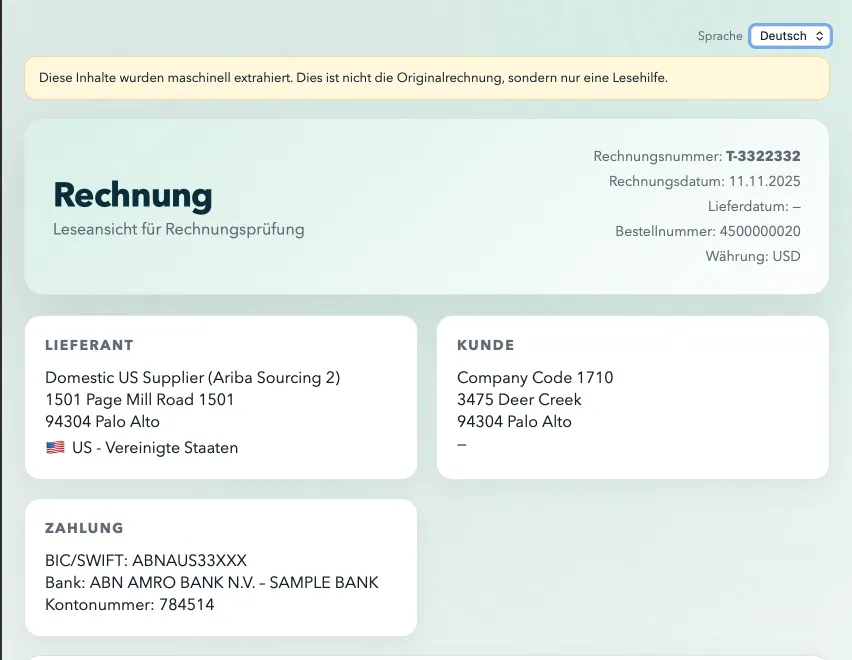
German
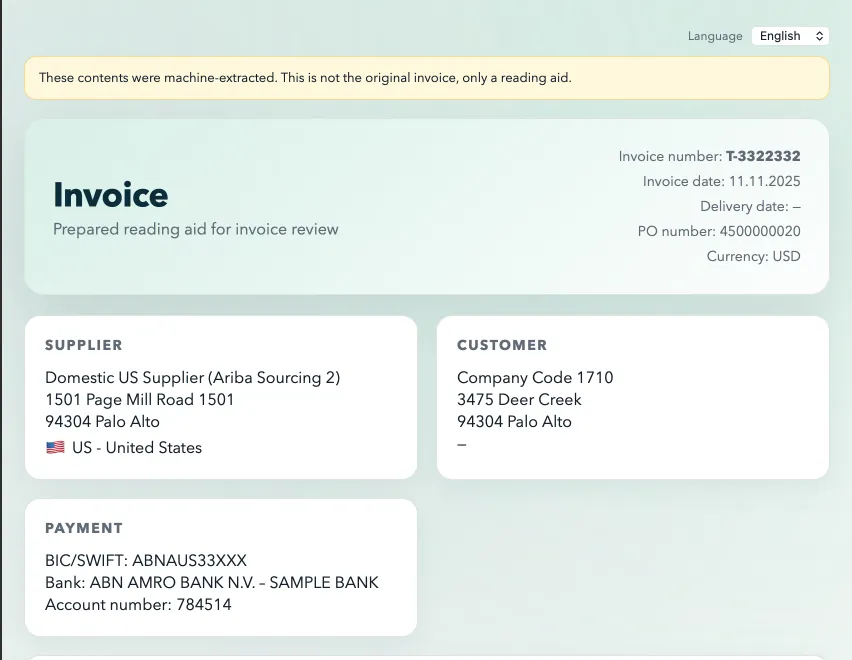
English
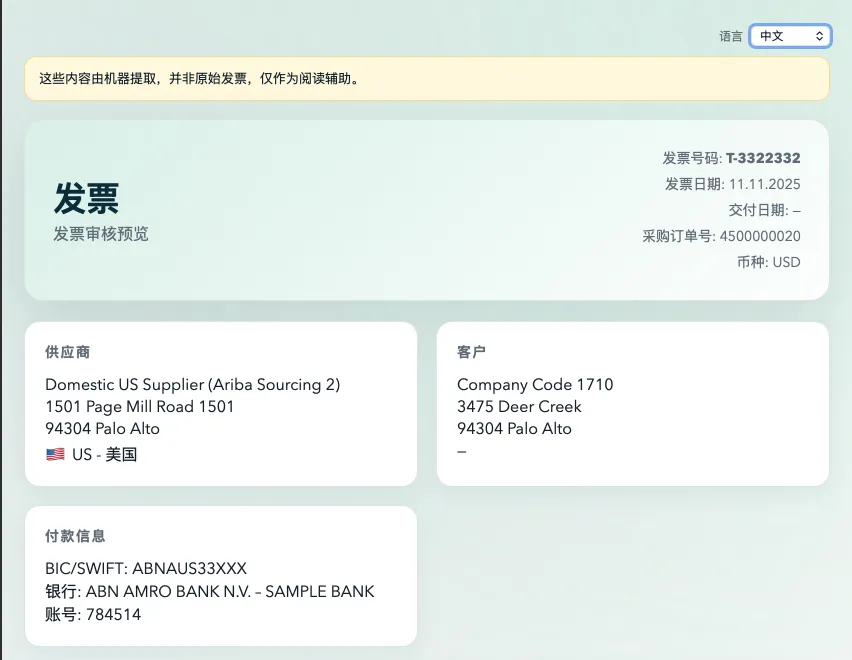
Chinese
The difference
Template recognition vs. semantic AI
Classic capture in SAP VIM — IC4S, CC4S and their predecessors — learns layouts. Semantic AI reads meaning. That single difference decides how much validation work remains.
| Template-based capture | Semantic AI (AIxVIM) | |
|---|---|---|
| New vendor | Layout has to be trained | Read correctly from the first document |
| Layout changes | Recognition breaks, training starts again | Irrelevant — meaning is read, not position |
| Line items | Frequently corrected by hand | Header and items read in context |
| Validation client | A permanent part of the process | Not needed for documents read correctly |
| Growing vendor base | Effort grows with every layout | Effort stays flat |
| Languages and formats | Configured per layout | Format-independent |
Both approaches can coexist: AIxVIM sits in front of the existing capture route, and anything it reads cleanly never reaches the validation client.
For enterprise teams
Control first. Scale second.
Nothing to migrate, no new project: AIxVIM starts with a controlled pilot on your invoices. Architecture, risk and success are agreed before scaling.
01
Integration without rebuild
Connected through the standardized CC4S API, inside the existing inbound process. Roles, workflows and posting logic stay unchanged.
02
Data residency & model access
Cloud or your own network: data location, tenant isolation and model access are documented as architecture decisions before the first productive document.
03
Controlled pilot
A defined invoice set, a measured baseline and agreed success criteria turn a demo into a decision you can stand behind.
04
Exceptions & fallback
Documents that do not meet the criteria enter a defined exception and validation process — nothing is silently lost.
Economics, not demo theatre
- Measure validation effort and extraction performance as a baseline
- Define the target state and measurable savings before the pilot
- Use the resulting data to decide whether and how to scale
Live demo
See it on your invoices
No slides. No buzzwords. Just your documents flowing into SAP VIM.
See your invoices without validationFrequently asked questions
Can AI extract data from invoices automatically?
Yes. Large language models read invoices semantically and extract header and line-item data with high accuracy — regardless of layout, language or format. AIxVIM passes this data directly into SAP VIM, so most invoices post without any manual validation.
What business value can I expect from AIxVIM?
AIxVIM reduces manual validation and rework, increases first-pass extraction accuracy, and scales invoice processing without proportional headcount growth — driving both time and cost savings.
Do I need to change my SAP VIM workflows or SAP system?
No. AIxVIM integrates without modifying your SAP system or workflows — it fits into the existing VIM inbound process, so you keep SAP-safe automation without changing your general process.
Is AIxVIM a cloud service or can it run in my network?
It can be used as a cloud-based service or deployed in a way that keeps all data within your own network. The integration with SAP VIM remains the same in both cases: AIxVIM connects to the existing inbound process without changing your workflows or SAP core logic. This means you can choose the setup that best fits your IT security policies, data residency requirements, and governance model.
AI invoice extraction: extracting invoice data with AI in SAP VIM
AIxVIM is an AI-based invoice data extraction layer for OpenText Vendor Invoice Management (SAP VIM). Instead of training OCR templates, it reads invoices with large language models — semantically, layout-independent and without manual validation.
How does AI extract data from invoices?
Modern AI models read an invoice the way a human does: they understand the content instead of matching templates. AIxVIM extracts header data — vendor, invoice number, dates, amounts, taxes, IBAN, purchase order number — and complete line items from PDF invoices, scans and multi-page documents, in any language and any layout. New vendors and changed layouts work from the first document, because there is nothing to train.
AI extraction vs. OCR and template-based capture
Classic capture solutions such as OpenText Intelligent Capture (IC4S) or Core Capture (CC4S) combine OCR with templates and machine-learning models. That works while layouts stay stable — and breaks with every new vendor, format change or non-standard document. The result is a validation queue that never empties. Semantic AI extraction removes exactly this step: it understands the document, so validation effort disappears instead of being managed.
Extract invoice data with AI — directly in SAP VIM
AIxVIM connects through the standardized CC4S API and runs inside the existing VIM inbound process. Business rules, approval workflows, posting logic and staging tables stay untouched — SAP VIM simply receives clean, usable data.
More than invoices: order confirmations, delivery notes, custom documents
The same AI extraction works for order confirmations, delivery notes, remittance advices and fully custom document types in VIM Beyond Invoices. As an SAP VIM consultancy, we integrate the extraction into your processes — from concept to go-live.
Cloud or on-premise: data protection and governance
AIxVIM runs with cloud models (for example Azure OpenAI) or with models operated entirely inside your own network. Data residency, GDPR and enterprise governance requirements decide the setup — the SAP VIM integration stays identical.
Test AI invoice extraction on your own invoices
The fastest way to evaluate AI invoice extraction is with your own documents: book a 30-minute AIxVIM demo and watch your invoices flow into SAP VIM — without validation.